
It began with Guy Clark's order for red beans and rice.
Shawn Camp says he owes so much of his musical success to his longtime songwriting partner, friend, and mentor, whom he first met while working the host stand at a Nashville vegetarian restaurant. The Perryville, Arkansas, native would go on to write Garth Brooks' "Two Pina Coladas," Brooks & Dunn's "How Long Gone," George Strait's "River of Love," and Josh Turner's "Would You Go with Me." He's also the newest member of the Nashville Songwriters Hall of Fame, inducted alongside luminaries like Lyle Lovett and Taylor Swift.
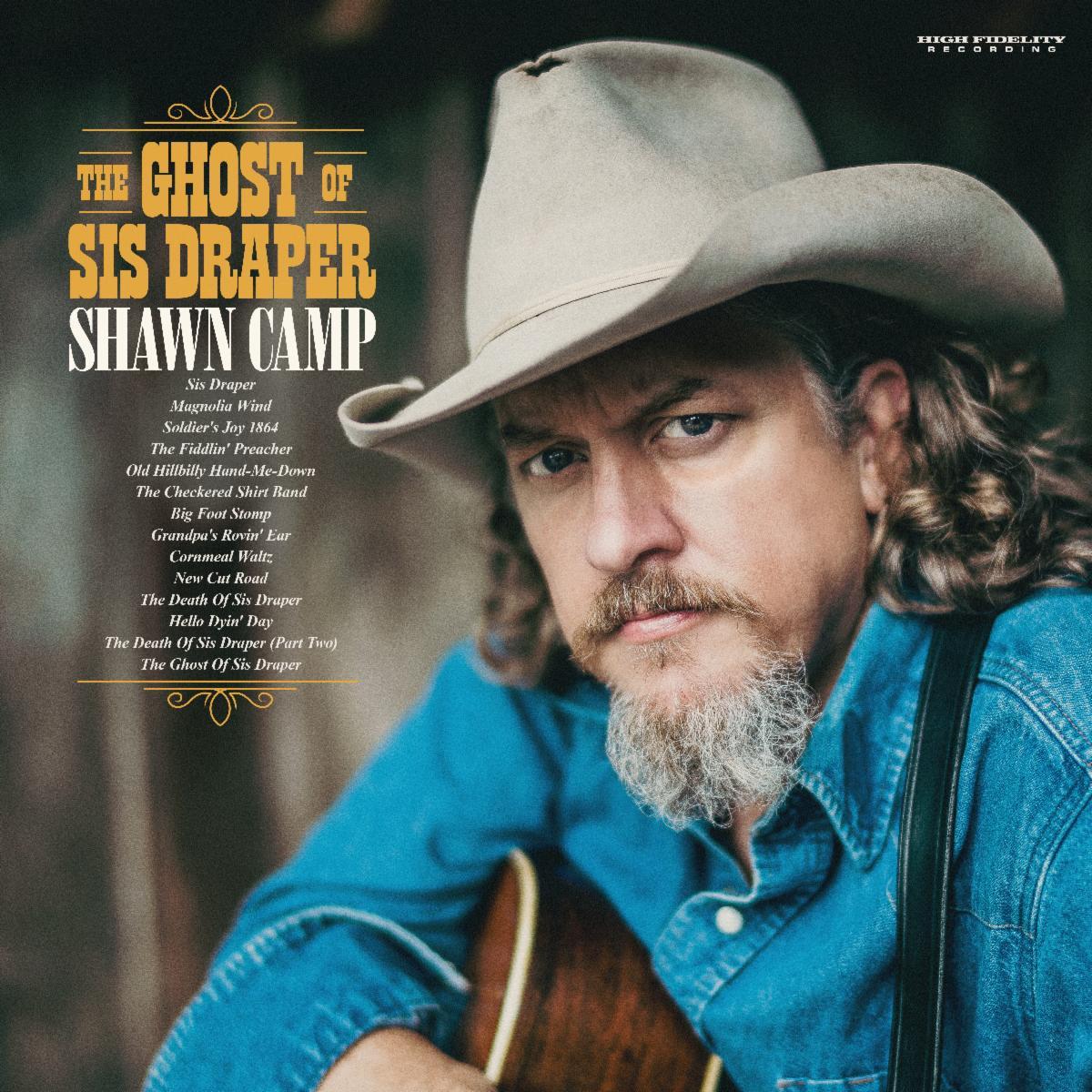
Camp’s latest album, The Ghost of Sis Draper (Truly Handmade Records), finishes what he and Clark started in 1998 and kept returning to until Clark's death in 2016: a song cycle about a real traveling fiddler who drifted through Camp's childhood. Six of the songs appeared on Clark's own records. The other seven are heard here for the first time.
Asked to name a signature song for his induction, Camp skipped the No. 1s and picked "Magnolia Wind," the second song he and Clark wrote about Sis. In our conversation with Camp, we talk about Clark’s influence, the Broadway-sized plans for Sis Draper, and what his Hall of Fame night was like.
Analogue: Do you remember the first time you met Guy Clark?
Shawn Camp: Yeah, I absolutely do. I have always worked in the music business as either a sideman for somebody in somebody's band or just whatever I could do to make a living. I was a production assistant for a record producer for a while, which was a glorified term for gopher. So I've done everything.
But one time I was working for the only vegetarian restaurant in Nashville, Tennessee. The only time I ever worked for a restaurant in any way was I was a busboy and a host. That's all I did. I wasn't a waiter by any means. That was an entirely higher-level class cat than I was ever going to be. All I thought about was music, really.
But I'm standing there as a host at the Slice of Life restaurant here in Nashville, and in walked Guy Clark, and the first thing he said was, "I want some red beans and rice." I said, "All right, sir. Yes, sir, I'm your host. I'll get your waiter and get you a table. Follow me." He said, "I want some red beans and rice," again, as we turned around the wall. So I get him to the table, and I get him seated, and I said, "I'll go get your waiter." And he said, "I don't want a waiter. I want red beans and rice." I said, "Okay, I'll go get your red beans and rice.” [Laughs]
Analogue: [Laughs] That’s incredible.
Shawn: Yeah, that’s the only time I ever served anybody in a restaurant, and that restaurant was right next door to Warner Bros. Records. So fast forward about five or six years, and I'm an artist on Warner Bros, and they're in a conference room with me, and they say, "Well, Shawn, if you could write with anybody in Nashville, who would you want to write with?" And I thought, "How about Guy Clark?" Just to challenge them and see if they could actually get Guyto write with me. And I swear, a week later, I'm sitting across the table from him, and we just hit it off, and we write this song called "Stop, Look, and Listen (Cow Catcher Blues)“. Guy liked to write songs where he would have alternate titles within the title itself.
"It seemed that he could cut away all the fat and get right to the lean truth of the matter, to cut it to the bone."
We hit it off and wrote that song, and I went ahead and didn't bother him for a couple of years. And then I went to my buddy Jim Rooney's wedding, and Guy was there. After the wedding, he's standing out in the yard smoking a cigarette, and he said, "Hey, Shawn, when are you gonna come back to the house and write another song with me?" And I said, "I'll be there tomorrow." And so I went over there, and we just really started writing after that. And we wrote quite a few.
Analogue: [Laughs] Did he remember the red beans and rice incident?
Shawn: I think I told him about it, but I don't remember if he remembered it even. But I remembered it, and it was a real highlight of my life to get to sit there and write with him.
Analogue: As you survey his body of work, do you feel like there’s a particular part of the craft that Guy had mastered?
Shawn: It seemed that he could cut away all the fat and get right to the lean truth of the matter, to cut it to the bone, really—the truth. He was good at that, and I think I learned a little bit of how to do that, but nobody can do it like Guy did.
Analogue: Did he start with a lot and trim it down, or did it come out of him that precise?
Shawn: He was just so cut and dry from the get-go, just like walking in that door and ordering those red beans and rice. He'd cut to the chase with everything. When they put him in the Nashville Songwriters Hall of Fame years ago, I was there, and I watched his speech. He walked up to the podium, got his little statue, and said, "Thanks," and turned around on his heel and left. That was his speech.
You know what? There's a cleanliness to that. There's no issues. He left everybody out and included us all, and it was beautiful. [Laughs] There was just a cut-and-dried perspective that he had on everything.
I brought his Old No. 1, the album cover, in there to him. I said, "Hey, Guy, we've been writing together for years, and I played that old album for years. Hey, man, if you don't mind, I'd like for you to sign this album to me." He goes, "All right." He goes, "To Shawn," then he writes and scratches a line, and then he goes, "Guy," and hands it over to me. I said, "Are you kidding me, man? You're not gonna put anything else in there, like something nice or something?" He said, "It'll mean more." And maybe it did. I don't know, man. That was him.
Analogue: How many songs did you two write together?
Shawn: I don't know, probably 30 songs or something like that. I really never have counted them, but we probably have, I don't know, 40 started total. There might be another 10 that we've got bubbling around that we didn't finish.
But he just opened so many doors in my life, really, and quietly. I didn't realize it was happening, but the doors were opening because Guy was sitting there, and he would associate himself with me, and let me be part of his picture. So yeah, he changed my life, really, Guy Clark did.
Analogue: You brought up his Hall of Fame induction, but you just had your moment as well. Congratulations!
Shawn: Oh man, it's shocking, really. I'm actually sitting here with it, the award. I really kind of never thought I'd get one of these. I used to write with guys that had them, and I'd see them on the mantel or something. It was like, man, that's strong. It's the highest point you can go in Nashville as a songwriter.
And I feel a little bit like an imposter, because I know I've written a lot of stuff and co-written a lot of stuff. I've written a lot of bad songs too. [Laughs] But a few good ones. I've been blessed to be able to write with a lot of my heroes and a lot of my mentors and old guys that I've looked up to for years, and a lot of those guys are in that whole thing. So it's an amazing thing to finally get into the club.
Analogue: Do you remember the moment you found out?
Shawn: I do. I was sitting in the Nashville airport with my buddy Verlon Thompson, and Verlon was Guy's sidekick for 25 years or so. We go out, and we do these tribute shows to Guy, and we do all Guy songs or things we wrote with Guy and tell stories about Guy. We've been doing that ever since Guy passed about 10 years ago. So I was sitting there in the airport at a gate waiting on a plane, and Mark Ford, who is the president of the Nashville Songwriters Hall of Fame, called me and told me I'd gotten in. That was the second week of August. I put him on speakerphone, and so Verlon heard it at the same time I did.
And Verlon sang "Magnolia Wind" for me at the induction ceremony, along with Emmylou Harris and my buddy Tim Crouch and Mike Bub. They played along with him, and it was just quite an honor. And to be getting in with Lyle Lovett and Taylor Swift and so many — Bruce Channel and J.I. Allison, Lee Thomas Miller. It's quite a class to come into it with.
Analogue: Is it surreal to say that just happened to you?
Shawn: Yes. I was hugged up with Taylor Swift getting pictures, and all these boys were around us, and I said, "All right guys, I'm gonna crop this picture out, and you guys ain't gonna be in this." Taylor was so cool, man. Sweet, sweet young lady. And I was thrilled to be going in with all those guys.
Analogue: I want to talk about the new project. About half of The Ghost of Sis Draper is coming out for the first time. Is that right?
Shawn: Right. I think six or seven of them had been out on Guy's records, and a couple of things I had on a Live at the Station Inn album. But there were things that were basically finished that we never demoed or anything that were part of that pile of songs. We wanted to turn it into a play, and we had been talking about it. So there are a lot of little dialogue, lyrics, and things that we've got that go between these songs that aren't included in the record. So I intend to flesh all that out and turn it into some sort of a little musical at some point.
But the other songs, some of them we didn't have melodies to, a couple of things that were more like raps, or we'd have all these verses that, phrasing-wise, the melody was there, but we didn't have the music to a couple of them.
I put three songs together to make the medley at the end of the album. We cut it all at one time, and the medley was not dissected into portions like the CD appears that it's dissected by track marks. We cut that one time, and that's the way it was: 10 minutes of music. So hopefully that's the way people will listen to it and not chop it up.
I start with "The Death of Sis Draper," and I get halfway through that song, and then I go to the last song that we wrote together, called "Hello Dyin' Day." I dropped that in as a deathbed confession from Sis, and then go back to "The Death of Sis Draper," and then that morphs into "The Ghost of Sis Draper." So all of that goes together. We had the same melody to "The Death of Sis Draper" and "The Ghost of Sis Draper." They were holding hands already until we wrote the last song we wrote together, "Hello Dyin' Day." And that was like, that's where it goes, in the middle of those songs. So Guy wasn't here to tell me it didn't. So I felt like it did.
Analogue: For people who don't know, who was Sis Draper?
Shawn: Well, I had heard about her from the time I was just a little kid. She was an extended member of the family and a friend of the family from the turn of the century. Her family grew up around ours, and so they always told me when I was a little boy, just trying to play music, "You really better get to practicing if you're gonna play with Sis Draper when she comes back home, because she don't just play with anybody. She's really something.” [Laughs]
They built her up to such a superstar status in my little kid mind. It's like she had a promotion team in front of her before my little kid's eyes saw her. And so she shows up with a beehive hairdo and a fiddle in a coffin case, and took her fiddle out and starts playing all the old-timey tunes that were 100 years old then. And man, I knew she was a world traveler, and she was always drifting through, playing fiddle.
So that's what I told Guy about her. We were stuck one day trying to write a song, and we were messing around with some other song, and he goes, "Well, that's your song right there." And then we started writing about Sis, and it just opened up the floodgates to all these memories, childhood memories, and I started sharing those with Guy, and we included those in this project. We started with that first song we wrote in 1998, and so all the way up until 2016, we were still adding songs to the pile. As we went along, we would work on other songs, write different songs, but if we ever got stuck on something, we would fall right back into the Sis Draper picture. And so that's how we ended up with all those songs.
Analogue: When did you realize there was going to be a Sis Draper record? Were you writing in that direction all along, or did you realize the songs were there for something bigger?
Shawn: It was clear when we wrote "Magnolia Wind," which was the second song. And then we had intention. It was like we had a reason to consider that, and that's where Sis's granddaddy came into play, and "Soldier's Joy, 1864." And another example of Guy's: we would put a title there, and then we'd put parentheses, like "Soldier's Joy, 1864," or "How I Became a Fiddle Player." He cut that and put it on a record. But we always intended to put it in one package and do a concept record at some point. And then in the middle of that, we thought about the play, and it just kind of grew from there.
"I've been blessed to be able to write with a lot of my heroes and a lot of my mentors and old guys that I've looked up to for years..."
Analogue: Is there a song you wrote with Guy that you're most proud of?
Shawn: Well, "Magnolia Wind." I chose that song to represent me in the Songwriters Hall of Fame as my signature song, because it just is a special piece. Rather than choose "Two Pina Coladas" by Garth Brooks, or "How Long Gone," or "Would You Go with Me," or any of those things that were hits, big number one chart successes, it just didn't seem to be the right sentiment to me to stand the test of time other than "Magnolia Wind." That just felt like a nice title.
It always works, and I don't know why, because it's probably one of the more simple songs that I have. But it just calms the crowd, and the women love it. So there. I gotta eat.
Analogue: When you say musical, what scale are you picturing?
Shawn: Well, I'm picturing it as like a Broadway musical. I don't know whether to do like a three-act thing, but it'll certainly stretch to 90 minutes, I know. So do the dialogue in between, and tell stories and narrate it a little bit, and have someone play Sis as the character, and have a couple of characters involved. I haven't fleshed it all out, but I do have dialogue and reasons for songs connecting to each other. I've never done this before.
At one time we spoke to a Broadway playwright about getting involved with this and doing a thing. We had him on speakerphone between me and Guy, and he's talking to us from New York City. And Guy finally said, "Well, the only way you're gonna co-write this is if you get your ass to Nashville." And the guy kind of shut down the conversation. He was done. But we don't want to hand it over to somebody who has no idea really of the storyline. So it's hard for us to hand it off, and it would have been hard to hand it off. So that's why I keep whittling on it.
Analogue: What else do you have in the works?
Shawn: I've got another album in the can that I've recorded. I've cut 14 songs for it, but I think I'm gonna do one more session. I haven't got it figured out as far as what label I'll be on, or if I'll just do it myself. But it's inspired by Johnny Cash and Cowboy Jack Clement, and all songs that feel like they would be something they would have done. Or in some instances, I got to put two melodies to two of Johnny Cash's poems.
And one is a song that was released. They found a lyric on 1958 Delta Airlines stationery called "I'm Coming, Honey," or "I'm Coming Home, Honey," it's what it was. And I took those lyrics and put a melody to them, and so they'll be included in this. But I've also written songs that I feel like Johnny Cash sent me from the other side. Man, that's kind of crazy, isn't it? But I feel like we're still connected. He's always been an inspiration to me, and I knew him a little bit through Cowboy Jack Clement.
And I've been talking to a couple of producers that are friends of mine, the great Don Cook and the great Paul Worley, and they're wanting to co-produce a new country record on me. I'm just gonna do real country stuff if I can. I don't know why, but I bounce around different genres a little bit. This record, Sis Draper, has a backing band that's all bluegrass musicians, and that's kind of been what I've been doing. But to me, the album is a country record, the Sis Draper thing, because it's just real country stories and stuff. Acoustic instruments just seem to be the way to go on that stuff. But I'm not opposed to cutting some electric guitars here and there.
VISIT: Shawn Camp
*Photo: Neilson Hubbard
